




Nathan Madsen
Staff Writer

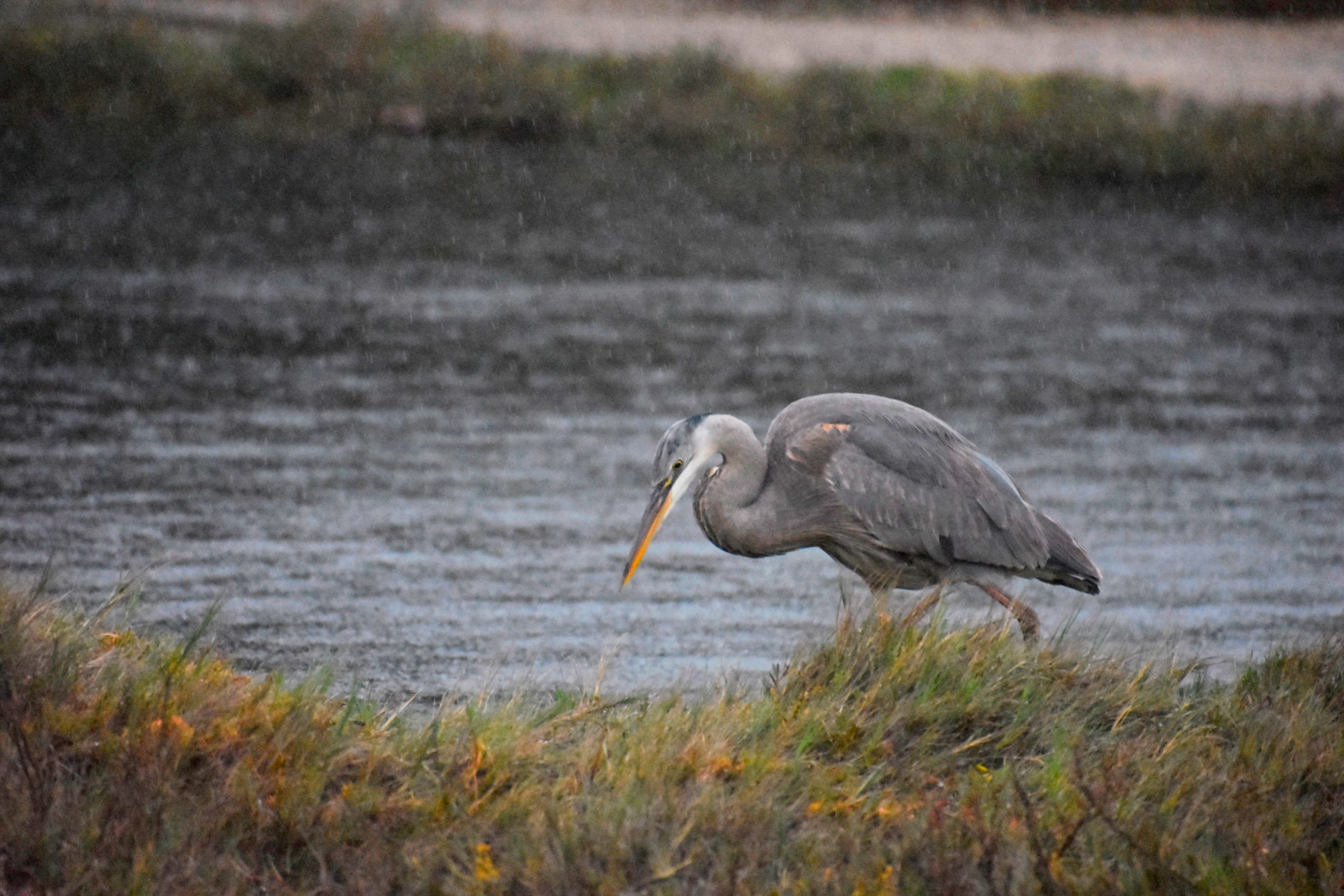
Great Blue Heron, Ardea herodias. UCSB Lagoon
I didn’t set out to see the heron. I was walking back from class, head down against the drizzle, when I looked up and noticed it — a great blue heron, neck drawn into an elegant S, standing still at the edge of the campus lagoon. It looked like a question the weather had asked. I stopped.
There was no dramatic motion, no flash of color or flight. Just the slow articulation of presence: a bird watching the water, and me, watching the bird. It’s hard to explain why I felt so briefly rearranged by the moment. I could tell you the species, describe its gait, mention that Ardea herodias feeds on small fish and amphibians. There is much to learn about the great blue heron. I could tell you its wingspan ranges from 167 to 201 centimeters, it has a height of 115 to 138 centimeters, weighs 1.82 to 3.6 kilograms, and exhibits a minor degree of sexual dimorphism. I could tell you that it is the third largest member of the genus Ardea, roughly half the weight of sub-Saharan Ardea goliath and slightly smaller than the Himalayan Ardea insignis. But that would miss the point entirely.
As I was wracking my brain for what to write to accompany all the bird photos I had sitting on my camera’s SD card, it was recommended to me that I write about the accessibility of birding, all that it can teach you about science, all that it can teach you about birds. The lagoon is right there.
Birding, however, is not a terribly efficient way to learn about science or even birds for that matter. I have watched birds for years, yet I constantly misidentify them and have trouble remembering their seasons. If you wanted to learn about science, surely any science class in the course catalog would be a better way to invest your time. If you wanted to learn about birds, you would be better off reading about them from Wikipedia or one of many books and pamphlets on local avians.
“Attention without feeling,” American poet Mary Oliver writes, “is only a report.”
Most ways of learning about birds give you reports: taxonomy, range maps, behavior guides, breeding seasons. Birding gives you something harder to name — the chance to feel what it’s like to see a bird. Not to know about it, but to encounter it. That difference, I think, is the whole reason to look.

Black-Necked Stilt, Himantopus mexicanus. UCSB Lagoon
This shift — from seeing as a method of identification to seeing as a mode of being with — is something the philosopher Maurice Merleau-Ponty called the “primacy of perception.” He argued that the world does not come to us as an object to be dissected, but as something lived and felt, through our embodied position in it. No longer cogito ergo sum, but rather an intersubjective conception of being. When I look at the heron, I don’t simply register its shape or label it as a species; I feel its stillness against my own movement, its distance folded into my vision. The lagoon, the heron, and I are all caught in a moment of mutual attention, a “flesh of the world,” as Merleau-Ponty would have put it.
French philosopher Simone Weil went further. For her, attention was the rarest and purest form of generosity. “Attention,” she wrote, “taken to its highest degree, is the same thing as prayer.” To wait for a bird, to stand still and watch for something that may never come, is to perform a kind of devotion. It is to open oneself not just to sight, but to surprise, and to the quiet possibility that the world might exceed our explanations of it.
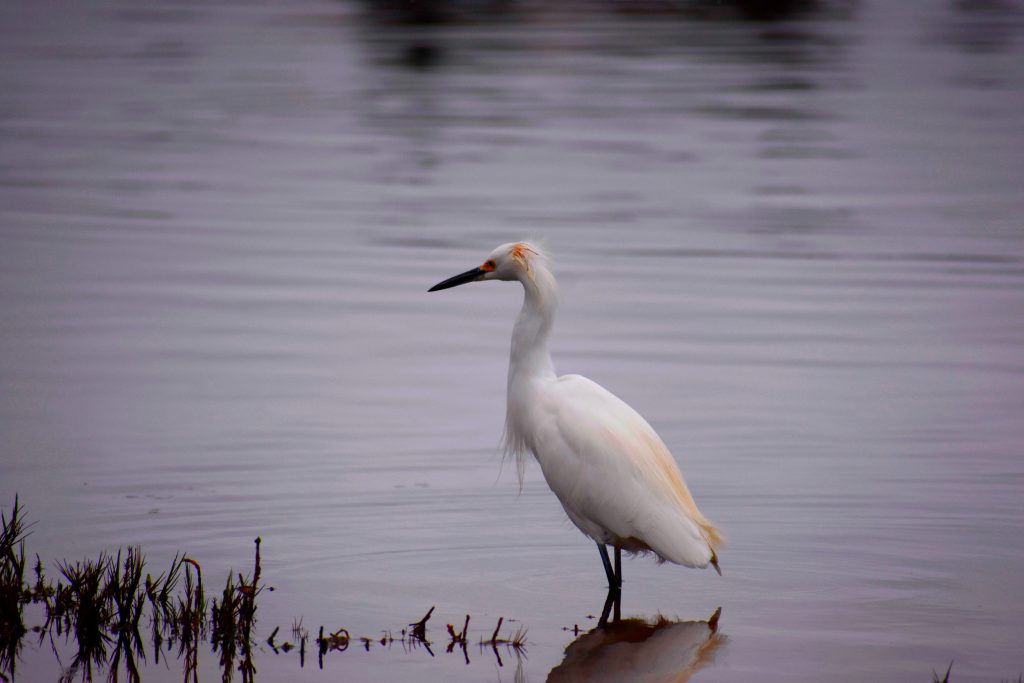
Snowy Egret, Egretta thula. UCSB Lagoon
John Berger, in his essay “Why Look at Animals?”, describes a parallel loss — not of birds, but of our capacity to see them as fellow presences. “Everywhere animals disappear,” he writes. “In zoos they constitute a living monument to their own disappearance.” They withdraw from our lives physically and more importantly from our moral and imaginative worlds. In the zoo, he says, animals are no longer observed but merely seen through. To truly look at an animal — not as specimen, not as symbol, but as being — is to acknowledge a relationship that resists easy language.
What birding restores, if only briefly, is that older grammar of encounter. It teaches us to look with feeling, not for data but for presence. And perhaps this is why it lingers: not because we remember the names, but because we remember the moments that felt, briefly, like prayer.