










Maya Clark
Staff Writer
Partners in Health (PIH) is a 501(c)(3) nonprofit corporation focused on promoting global health and health equity organization. Best summarized by their slogan “injustice has a cure,” they are actively working in 11 under-resourced countries to bolster these values. Some of their more well-known projects have been highlighted by Hank and John Green’s ongoing donations and fundraising towards PIH’s commitment to reducing maternal mortality rates and tuberculosis.
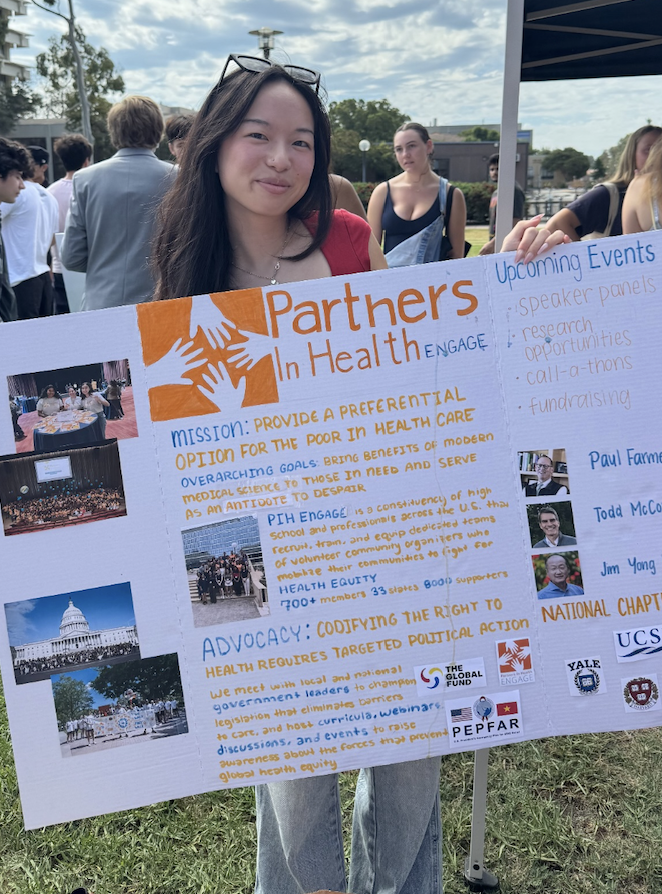
Recently, UC Santa Barbara (UCSB) has officially gained its own chapter — its first organization dedicated to global health equity. After being in the UC Global Health Institute Student Ambassador Program, fourth-year pre-medical student Sophia Zhu was looking for more opportunities to engage with global health equity but found little on offer in terms of campus organizations.
Engage is a PIH program focused on student involvement in fundraising, advocacy, and community engagement. When Zhu found out about Engage, she submitted an application in fall quarter of last year. After undergoing the interview and initiation process this past summer, Zhu now leads the all-women board of this new Registered Campus Organization (RCO).
In an interview with The Bottom Line (TBL), Zhu described the relationship with Engage as proactive. “Our chapter gets coaching, we have to meet pretty frequently,” she stated, “[about] once a month [with] the national organization.” PIH Engage at UCSB follows the goals that the overarching organization decides on each year, as students are unqualified to provide direct medical care. “This year, the main focus is on acquired immunodeficiency syndrome (AIDS) and tuberculosis,” Zhu explained to TBL, in partnership with the President’s Emergency Plan for AIDS Relief (PEPFAR) and The Global Fund, which focus on tuberculosis, malaria, and human immunodeficiency virus (HIV).
PIH Engage at UCSB’s priorities for the remainder of the year are primarily concerned with advocating for policy and Congress for these diseases. In particular, PEPFAR, which matches $2 for every $1 contribution, is currently withholding $3 billion dollars, half of its total contribution. To compound this, PEPFAR is up for reauthorization, so its funding and its continuing operation are under threat amidst the current government shutdown, alongside severe cuts to foreign aid and massive changes in attitudes toward healthcare and abortion. Zhu and other Engage chapters, along with PIH itself, are meeting with congresspeople to emphasize the importance of this previously bipartisan legislation.
For the 100+ high school and university chapters in Engage, PIH as a greater organization provides many opportunities to pursue after growing out of Engage. Zhu listed some of these opportunities, including becoming involved in leadership positions within PIH Engage program’s national headquarters team (available to students, professionals, and organizers), physician training programs, and partnerships with Harvard Medical School and its School of Public Health, and the teaching hospital Brigham and Women’s Hospital. PIH wrote in their website that this collaboration serves as “a fruitful model for leveraging the resources of the world’s leading academic institutions to inspire, enlist, and train others to address the pressing health inequities of our times.”
PIH remains ahead of its time within healthcare advocacy despite being formed fairly recently in 1987. Outside of academia, “there’s not a lot of resources on how to provide culturally competent care in hospitals, especially in private practices,” claimed Zhu. According to her, it’s fifty-fifty on pre-medical student interest in health equity at UCSB. All of the current members of the RCO are part of the first half which are concerned and invested with global health issues. They have a direct relationship to disempowered communities impacted by health disparities — whether having experienced marginalization themselves or having traveled to under-resourced communities and witnessed the medical inequities. She believes the other half who are not invested in global health equity and public health is due to Santa Barbara itself being a privileged and isolated area, which makes it easier to ignore the glaring global issues in healthcare surrounding us.
The PIH Engage at UCSB board currently consists entirely of pre-medical students, but public health and health equity are universal issues that extend beyond M.D. or D.O. fields. Zhu noted, “No matter what you want to go into, healthcare access and global healthcare is something that impacts all of us, and it’s even more important in today’s political climate to know what’s going on.”
The club is currently conducting outreach to other majors, and so far, they have spoken with political science, environmental science/studies, and feminist studies majors through the fall 2025 course Feminist Perspectives on Health.
As PIH Engage at UCSB continues to grow, it hopes to collaborate with other chapters throughout Southern California (including San Luis Obispo and University of Southern California) on a 5K fundraiser. They plan on having each member create a fundraiser page through PIH.
Zhu has been greatly disturbed by the severe inequities around the world and the vast gap between our privilege, as much as our country’s system is criticized. While that has not entirely abated, being part of the progress toward equitable healthcare and raising awareness for global health equity creates a sense of purpose that eases some of that distress. After participating in PIH Engage, she hopes to continue working in global health equity in some way, and she and the other members will hopefully be able to bring this methodology into practice and beyond the ivory tower — perhaps even into the under-resourced countries that PIH serves.
PIH Engage at UCSB can be found on Instagram @pihengageucsb and reached at pihucsb@gmail.com.