



Simai Kang
Campus Beat Reporter
On Oct. 7, the Royal Swedish Academy of Sciences awarded the Nobel Prize in Physics to John M. Martinis and Michel H. Devoret, two professors in the Department of Physics at UC Santa Barbara (UCSB).
Devoret is a French physicist and a professor at Yale University and UCSB. He works for Google as a quantum hardware scientist. Martinis graduated from UC Berkeley with a PhD in 1987, and he led the team to develop a superconducting quantum computer at Google Quantum AI Lab, a partnership between Google and UCSB.
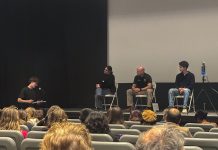
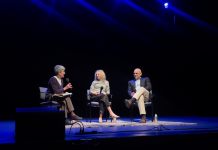
“Soon after the experiment, what was clear was that we had made the first artificial atom, an atom that does not exist in the natural world,” stated Devoret in a colloquium held at UCSB.
An artificial atom can be used in advanced technologies like quantum computers and high-performance displays to show energy levels and to mimic natural atoms. Devoret joked, “We are just as stressed as the atoms.”
“All the individual atoms connect to their neighbors, but then that matters that microscopic connection is kind of just added on, atom by atom. At the end, you get big crystal facets, and it tells you it’s microscopic and exhibited to macroscopic,” Martinis said.
Microscopic phenomena can only be seen through a microscope, but when exhibited on a macroscopic scale, we can see them with our naked eyes.
Because of the crystals, you can see that a microscopic particle can go through an energy barrier, such as a wall on a macroscale, which our human eyes can capture. Martinis then went on to joke about California’s healing crystal industries, with reference to his own revolutionary work with quantum crystals.
The device for making such a tunnel is called a “Josephson junction,” which is composed of two superconductors separated by a thin non-superconducting barrier in between, right before quantum tunneling. It then turns into an open circuit to pass through the barrier.
Quantum tunneling in physics refers to the phenomenon where a particle hits a barrier, but rather than bouncing back, the particle instead goes through. It’s like the particle has the superpower to phase through walls, but it’s no longer a matter of a comic book. It’s in science now!
The two Nobel Prize-winning professors shared on goal in their discoveries, chasing a single question: What is fundamentally true about reality?
“The essence of basic fundamental science begins with curiosity; it thrives on the courage to pursue problems that are deep, complex, and at least at the time unsolvable. It’s not about media chaos, it’s about being brilliant minds and the freedom to think,” said Shelly Gable, the current dean of the Division of Mathematical, Life, and Physical Sciences at UCSB, at her congratulatory speech after the colloquium.
Investing in science is investing in the future’s unexpected miracles. These quantum discoveries remind us that truth matters and that curiosity still leads in science. Without doubt, science is rigorous and resilient.
“As a freshman, I wasn’t sure if I had attended the correct school. But after hearing this, I was sure that I had picked the right school since we are being recognized globally, and it’s a good feeling that faculty members from my school won such a prestigious award,” first-year Dixon D. Ciru Cruz concluded in an online interview with The Bottom Line.