







Taylor Cusimano
Contributing Writer
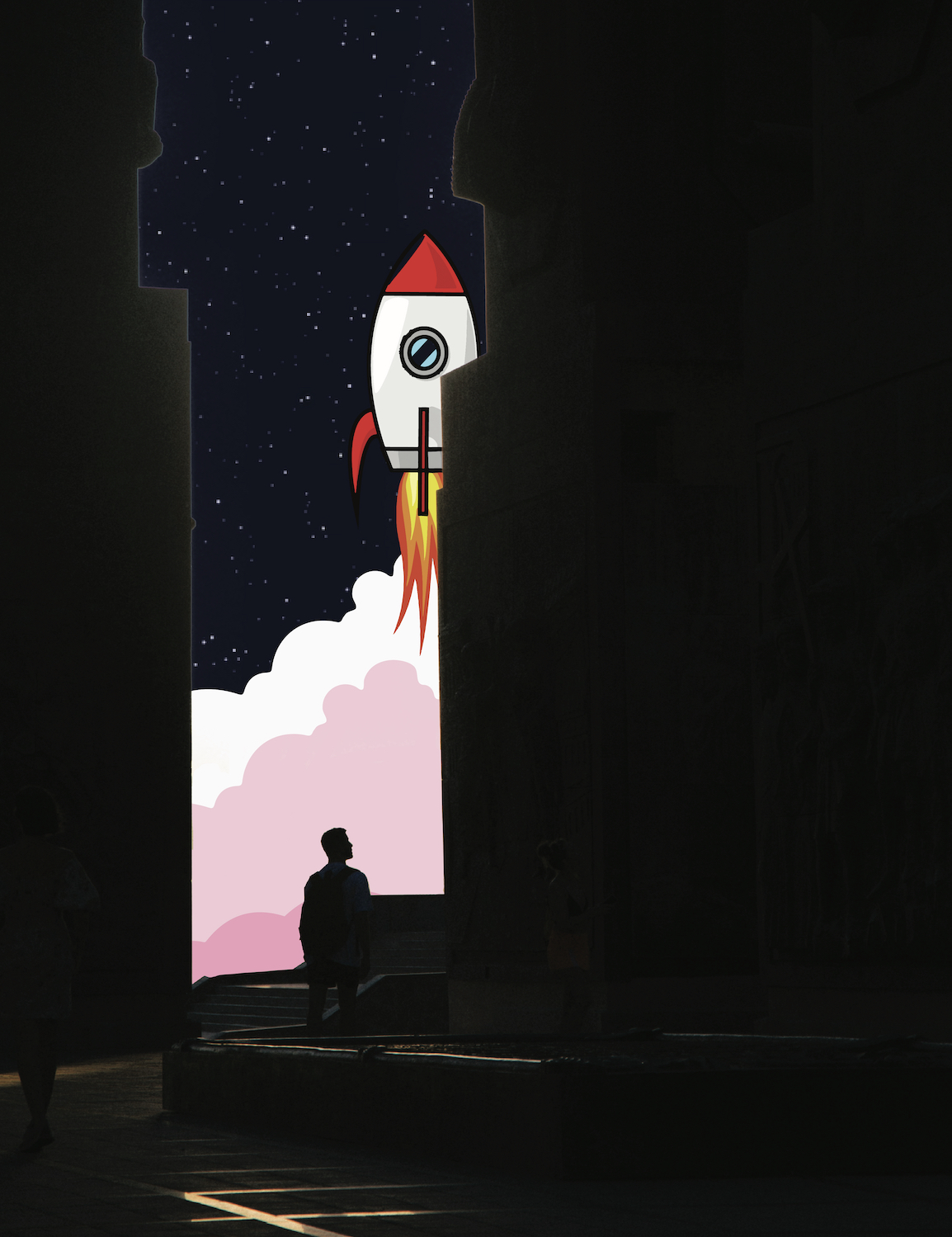
On April 14, six women soared into space aboard Blue Origin’s NS-31 mission, a privately-funded suborbital flight that captured global attention. Organized by Lauren Sánchez, fiancée of Blue Origin founder Jeff Bezos, the mission featured pop star Katy Perry, journalist Gayle King, aerospace engineer Aisha Bowe, civil rights advocate Amanda Nguyen, and film producer Kerianne Flynn. In ten minutes, they challenged the historically male-dominated frontier of space exploration.
Sánchez’s vision for the mission, shared in an Elle Magazine interview, resonated deeply on campus: “All of these women are storytellers in their own right. They’re going to go up to space and be able to spread what they felt in different ways.” At UC Santa Barbara (UCSB), the mission catalyzed reflection, engaging students and faculty across disciplines. The Humanities and Fine Arts Division hosted a spring creativity contest, where one student reflected on the flight through a submission.
David Gjerde, a second-place winner in the contest, explored the mission’s broader impact in his statement, “Bezos’ long-term vision includes mass commercial space flights and satellites to improve global connectivity. If his hawk-like business philosophies are carried through, maybe our children will get to see our home. Maybe they would see how fragile it is, or how fragile we all are.” Gjerde acknowledged the mission’s $28 million cost and environmental challenges yet urged readers to “marvel at the idea of it,” reflecting the tension between aspiration and practicality that fueled campus conversations.
Despite the possibilities implied, the mission sparked significant criticism. Actor Olivia Munn turned heads when she questioned the flight’s objective. “I know this probably isn’t the cool thing to say, but there are so many other things that are so important in the world right now,” she said during an interview. “I know this is probably obnoxious,” she added, “but it’s so much money to go to space, and there’s a lot of people who can’t even afford eggs.”
Although the company does receive federal funds through contract work, no taxpayer money was used for the NS-31 mission on April 14 — everyone aboard flew at private expense. Bezos owns and funded the company and has not billed any government agency for this suborbital flight.
In an interview with The Bottom Line, feminist studies professor Anisha Thomas offered a more nuanced perspective, celebrating the mission’s symbolic power while reflecting on its scope. “One of the amazing things about being human is that we don’t just do what’s necessary. We dream big, create weird and wonderful things, and build rocket ships just because. Space travel encapsulates so many of these human complexities — it’s totally unnecessary for survival, wildly hard, and ridiculously fun. But it’s true this mission wasn’t necessary, and the real tragedy? It was only mildly imaginative.” She added, “My approach to progress is ‘how much does it expand our choices, options, or just our imagination of what can be?’ It’s a riff on very standard development theories.” Thomas’s perspective embraced the mission’s push for diversity.
The Blue Origin mission continues to spark conversations around the world. For some, it felt like a flashy display; for others, it was a meaningful step toward expanding the image of who belongs in space. For UCSB, the mission was more than a headline. Through voices like Gjerde’s and Thomas’s, UCSB continues to challenge assumptions, inspire creative visions, and reimagine what space exploration can mean for humanity, both on Earth and beyond.