







Ariana Isabel Duckett
News Editor
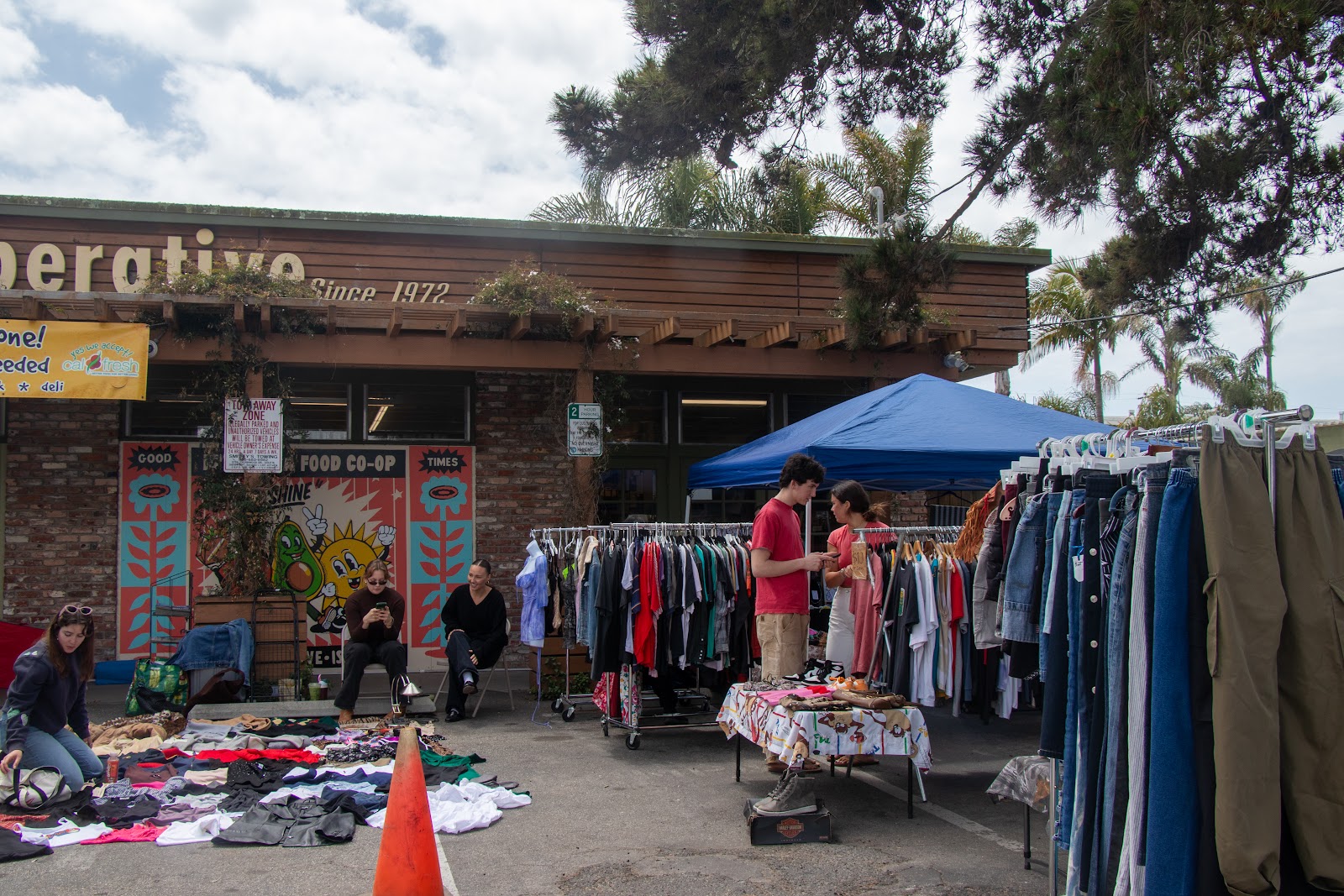
On April 25, small business owners from the Isla Vista (I.V.) Small Artists Cooperative (Artists Co-op) hosted the Co-op Support Market in the front patio and parking lot of the I.V. Food Co-op (IVFC). Vendors donated 10-20 percent of their profits to IVFC.


IVFC has faced a financial crisis since January due to ongoing loss in revenue and the rising costs of “insurance, payroll taxes, and utilities.”
Robbin May Balagtas co-founded the Small Artists Cooperative for I.V. small business owners and community members to organize markets and support one another’s business ventures. Balagtas reached out to Lisa Oglesby, the president of IVFC’s Board of Directors, to host the Co-op Support Market.
Balagtas then offered to collaborate with IVFC. “My business structure is, we work together to help build each other up,” Balagtas told The Bottom Line (TBL).
Preventing a “Food Desert” through Community Engagement
Preston Towers, IVFC’s Point of Sale Manager, has worked there for six years and seen how “students cycle out” each year. IVFC must work to re-engage each new community member who steps through their poster-covered automatic sliding doors.
“Community-owned spaces are more important now than ever,” Towers told TBL, because of “the erosion of third spaces.”
Third spaces are public gathering spaces for people “from different walks of life” to be able to come together, according to Towers. These places include bars, clubs, and supermarkets — individuals would not otherwise meet one another if not for them.
Towers was not directly involved in organizing the Co-op Support Market but has seen a “more concerted effort” by the owners and employees of IVFC as well as community volunteers throughout IVFC’s financial crisis.

IVFC also has a second location in downtown Santa Barbara, which has mitigated but not solved IVFC’s financial crisis. “We haven’t said we’re closing,” Towers told TBL, and that restoring funds “requires help.”
The resilience of the community, as well as the initiatives of the IVFC Board of Directors, can help IVFC keep running. “A lot of people don’t want to see this go away, me included,” Towers said. IVFC has operated for 50 years, and “we want to be here for another 50.”
Riley Jordan has run Glass Door Jewelers since she was a freshman in high school. Jordan told TBL that when she arrived at UC Santa Barbara (UCSB), “I really struggled to find something because I didn’t really know about the Artists Co-op.” She had previously only known about Thriftopia, which is not hosted as often.

Jordan described finding “little support groups” in the Artists Co-op, where vendors help one another, for example, by watching over their stand while they get food. “Usually, like, the people I sit next to, I end up becoming friends with.”
According to Jordan, “[I.V.] will become a food desert without [IVFC],” and IVFC contributes to the “little student area” I.V. is. “Part of that is having an accessible grocery store.”
Creating the Small Artists Cooperative to Coexist and Support Fellow Vendors
In addition to co-founding the Artists Co-op, Balagtas is the Thrift Coordinator of xRebelliousBow, an I.V.-based secondhand clothes business. Balagtas co-founded the Artists Co-op in December 2023 — the year she graduated from UCSB — when the I.V. Parks & Recreation District (IVRPD) stopped allowing vendors to sell at the parks without a seller’s permit.
“There was so much division in the community when that happened,” said Balagtas.
Some vendors began blaming each other for the IVRPD’s decision. “We were like, ‘Oh, you lost the parks ’cause you wanted to [make] money off of it,’” Balagtas said, or that IVRPD “started regulating the parks because [they] don’t want out-of-towners.”
Balagtas said that “the park should be preserved … But I just feel like just basically banning everyone from using the park was, like, really excessive.” Balagtas thought employing an event organizer would have helped run markets at the parks.
Several vendors were uncomfortable with getting a permit.
Balagtas hasn’t spoken directly with park staff, but at a board meeting she told the story of a homeless vendor who also sold clothes at Little Acorn Park and who was impacted by the regulations on vendors. “I need you here,” the vendor had said to Balagtas.
“A lot of organizers have felt threatened by me when I’m like, bro, I’m just trying to create a safe space,” to hang out and have fun, for all types of vendors — those trying to make a living, fulfill a hobby, or declutter an apartment. “It doesn’t have to be so [expletive] cutthroat,” Balagtas said.
“I formed the [Artists Co-op] to help lower, to try to decrease those barriers to getting vendor spaces,” by both creating spaces that did not require permits and educating vendors on how to get a seller’s permit. “After the whole regulation thing just like pushed in, and just made the parks more exclusive, I had to [help] create that space.”
The Artists Co-op took inspiration from IVFC in numerous ways. In addition to having “cooperative” in the name, “I like the business structure that values giving back to your community,” Balagtas said. “It’s not just a self-fulfilling thing.” IVFC’s products are fair trade and ethical, and IVFC cares about “what the customers want to see at the store,” which connects to her own business model.
“My thing is trying to build community through the market scene,” Balagtas said, and continues trying to better connect with customers and community members.
“Look, it’s hard, you know, doing all this by yourself. I’ve seen some [expletive] just starting my own business over [expletive] selling clothes. I don’t want anyone to go through what I went through just trying to belong in this field.”