




Leslie Yang
Staff Writer
On Oct. 1, the United States (U.S.) federal government shut down, resulting in an indefinite pause in most federal agencies and their operations. The shutdown came as the Senate failed to pass a crucial bill to fund various federal programs and services for the 2025-2026 fiscal year.
Democrats have largely been a united front in their concern for budget cuts on healthcare services, namely, Medicaid and tax credits on health insurance under the Affordable Care Act, claiming these cuts could potentially affect millions of Americans’ accessibility to necessary healthcare services.
In an interview with The Bottom Line (TBL), Santa Barbara Representative Salud Carbajal (CA-24) stated that in the Central Coast alone, the Trump administration’s “One, Big, Beautiful Bill” has already “put nearly 30,000 residents at risk of losing their health coverage.”
Congressman Carbajal went on to state that under passage of this Republican spending bill, “another 10,000 people in our community will lose their coverage— and that’s not to mention the roughly 35,000 Central Coast residents who will see their health insurance costs more than double without those tax credits.”
While many federal agencies have been temporarily interrupted, most crucial services such as Social Security, Medicare, and Medicaid, will not be immediately affected. However, an extended shutdown may cause some tangible disruptions.
Congressman Carbajal stated that essential services “will still be functional but people might experience delays,” encouraging Central Coast residents to visit his website’s government shutdown FAQ page for more specific information.
Similarly for the University of California (UC) system, the UC Office of the President (UCOP) released an informational page stating that they are monitoring the shutdown and that “the short-term impacts on UC are expected to be limited, but the long-term picture is less clear,” with the caveat that “UC campuses won’t be able to draw down federal funds, and agencies are unlikely to issue new contracts, renewals, or awards until the shutdown is resolved.” They have also encouraged concerned students to visit the UC Office of Research and Innovation’s shutdown guidance webpage.
The UC system is a major recipient of federal funding as one of the largest providers of Medicaid in California, with 35 percent of students receiving Pell Grants (federal grants for those demonstrating exceptional financial need), and many more receiving work study and student loan services.
Additionally, 33 percent of UC undergraduates are eligible for SNAP/CalFresh benefits, which are partially funded by the federal government. While there is little possibility that student financial aid or health care will be impacted during the shutdown, it is possible that November SNAP payments may be delayed or halted.
These program halts come at a time when the Trump Administration’s “One Big, Beautiful Bill Act” (OBBBA) has already financially weakened the UC system. Both Californians and UC students face the consequences of these budget cuts. The OBBBA decreased the overall budget of SNAP/CalFresh by 20 percent. For Californians, this means that 18,000 will lose their food assistance benefits while 444,000 will see reductions.
Cuts from Medi-Cal (California’s name for Medicaid) would cut health coverage for 3.4 million California residents. Additionally, the UCOP budget report for the fiscal year of 2025-2026 cited that due to “uncertain investment returns and federal action considerations,” the UC President and campus chancellors have implemented cost cutting measures such as a hiring freeze.
In an interview with TBL, an electrical engineering grad student described the new struggles these budget cuts have caused. He stated that these cuts have reduced Teaching Assistant (TA) positions, which come with the benefit of waived tuition, making it much more difficult for graduate students to be hired. Another major consequence is a decrease in research funding: “If your lab heavily depends on federal funding, you’re gonna have a tough time right now. And I have heard cases where the federal funding was just cut, and they can’t bring on new students.”
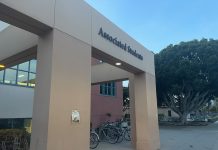
Associated Students (A.S.) Senator Noah Luken stated that “the true evil of budget cuts is that they do not just affect the program that gets cut, but the entire university and campus as a result.”
The length of the government shutdown is unclear, however, the immediate resolution of the shutdown is crucial considering prior cuts to the federal government. Luken stated that he and UCSB’s A.S. body “are monitoring government trends to ensure that A.S. is doing everything it can to prevent and mitigate potentially harmful effects,” assuring that campus programs and initiatives such as the A.S. Food Bank and the Commission on Student Well-Being will continue to work tirelessly to serve students. However, this does not mean that UCSB will not be affected by both past and anticipated budget cuts.
When asked under what conditions he and the Democrats would be willing to pass the funding bill, Congressman Carbajal emphasized that the blame for the shutdown largely lies on Trump and the Republican party stating that they “manufactured the crisis,” and that they “alone bear responsibility.”
He went on to say that the Democrats are united in their objectives of passing a spending bill that “opens the government and stops a full-blown healthcare crisis by protecting health coverage and preventing skyrocketing out-of-pocket insurance costs for millions of Americans.”
Both parties continue to decry the negative effects of the shutdown as the impasse continues, but even as tensions rise, the length of the shutdown remains uncertain.
I believe this website has got some rattling superb info for everyone :D. “The public will believe anything, so long as it is not founded on truth.” by Edith Sitwell.
Comments are closed.