







Ariana Isabel Duckett
News Editor
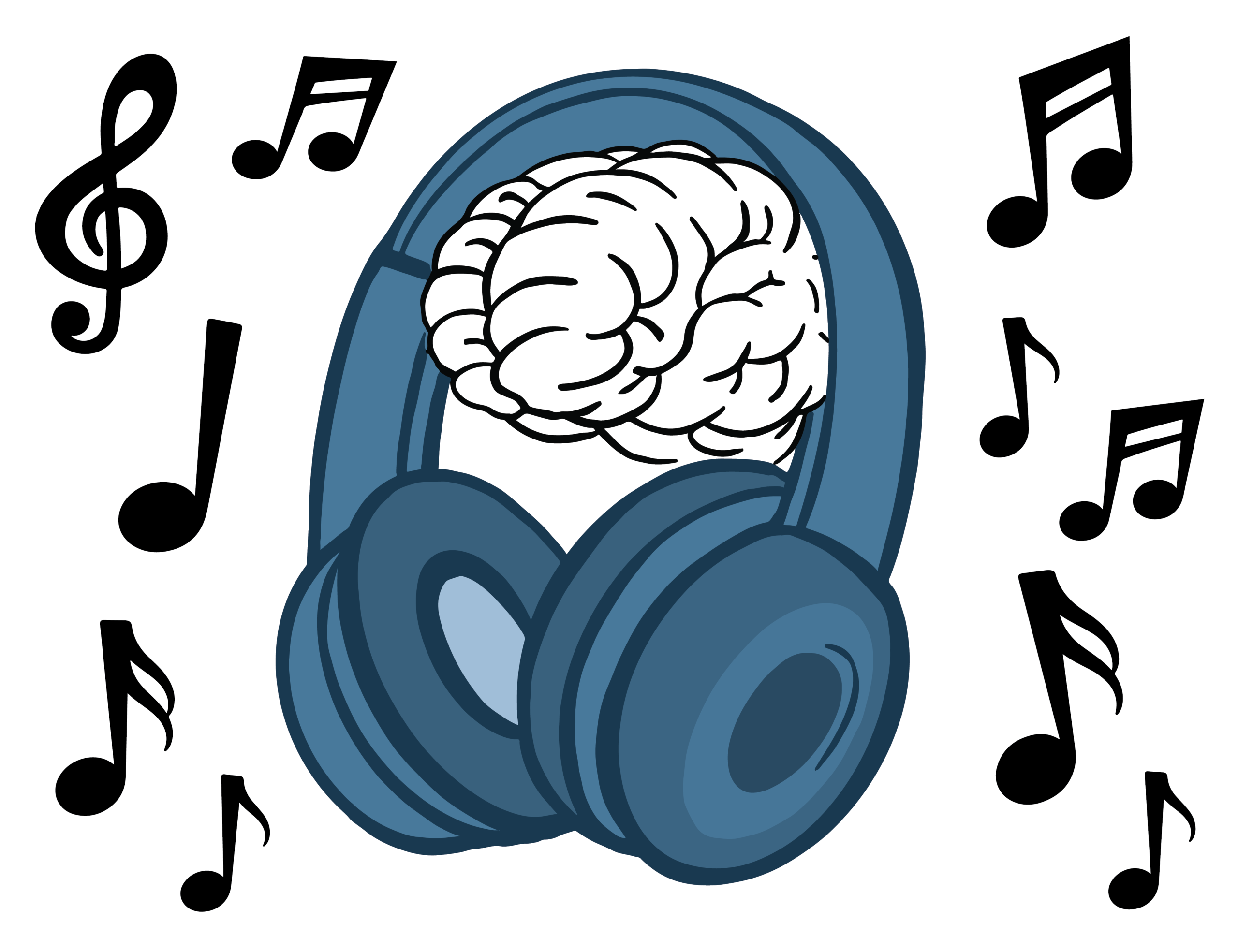
From apartment balconies to Skullcandy headphones, music constantly permeates UC Santa Barbara (UCSB) and its surrounding community. What makes us prefer different genres?
Music psychology explores this phenomenon — the personal yet universal resonation individuals experience with the music they listen to.
The Bottom Line spoke with Dr. Janet Bourne, an assistant professor of music theory at UCSB, about the phenomenon of students’ music tastes and the brain’s responses to those choices.
Dr. Bourne leads the Music Cognition Lab at UCSB, which studies the relationship between cognitive processing and music perception through several types of experiments. Its current projects include analogical processing and theme categorization, modes of listening and meaning, music effects on film perception, and musical topic associations.
Film music is a central aspect of the lab’s research, according to Dr. Bourne, but musical narratives still thrive in everyday listening. Any genre of music one decides to listen to tells a particular story of the listener’s mood, past, and goals.
Focus, Mood-Regulation, and Background Music: Choosing the Right Song for the Right Situation
Dr. Bourne has observed “a lot of individual differences” in the many studies that analyze the influence of background music on completing certain tasks. Every listener has a unique personality and background that shapes their music taste.
Studies more consistently find that “individuals who are better at controlling attention are less likely to be distracted by music during cognitive tasks,” according to Dr. Bourne. “Those people are more likely to listen to music.”
Dr. Bourne has also found that “if people have the opportunity to choose their own music, [they’re] going to be more likely to perform better on cognitive tasks than if I were to choose the music for [them].”
Music listeners also often choose specific types of music for certain types of tasks — music for running versus studying will often come from different genres. “You feel different emotions when you’re listening to different kinds of music,” Dr. Bourne explained.
These emotional responses are explored in a framework known as BRECVEMA.
BRECVEMA and Musical Emotions
Patrik N. Juslin coined the term BRECVEMA in his 2013 research article on musical emotions. His research added an additional letter to the previous BRECVEM framework.
Juslin’s “Musical Emotions Explained,” which can be found at the UCSB library, further explores these eight “mechanisms” of emotional response: Brain Stem Reflex, Rhythmic Entrainment, Evaluative Conditioning, Contagion, Visual Imagery, Episodic Memory, Musical Expectancy, and Aesthetic Judgment.
“Musical sounds are imbued with meaning,” Juslin writes of humans’ sound perception, but that “music arouses emotions only in about 55–65% of the episodes on average.” Roughly 12 percent of these emotional responses are “mixed emotions,” such as the combination of joy and sadness.
“Groovy” Music and Embodied Cognition
“We’re not just walking brains … our mind is in a body,” Dr. Bourne said of embodied cognition, which studies how the body influences the brain. For example, humans have “really strong tendencies to want to move to music.”
Rhythmic entrainment, the “R” of BRECVEMA, studies the relationship between body rhythm and music rhythm, such as the physical effects of dance music. The “strong rhythms” of the genre, which can be “perceived as groovy,” evoke positive emotions, according to Dr. Bourne.
Evaluative conditioning occurs when “an emotion is induced by a piece of music simply because this stimulus has often been paired with other positive or negative stimuli,” according to Juslin’s research paper. Aesthetic judgment centers on the perceived “beauty” of a piece, Juslin writes in “Musical Emotions Explained,” which is an “individualized process.”
The episodic memory mechanism pertains to memories of specific life events, associating music with moments such as graduation, according to Dr. Bourne.
The past also carries through in music when listening to songs or genres considered nostalgic, a phenomenon known as the reminiscence bump.
The Science Behind Blasts from the Past
Carol Krumhansl’s “Cascading Reminiscence Bumps in Popular Music,” accessible through the UCSB library, discusses the significance of music heard during one’s teenage years. “The music encountered during one’s late adolescence and early adulthood has the greatest impact on individuals throughout their lives,” Krumhansl writes. “Studies of older adults show, for example, that music from their youth is recognized more often, more facts are known about it, and that it evokes more specific autobiographical memories and strong emotions than music from later in life.”
According to Dr. Bourne, the influence of a caregiver’s nostalgic music preferences can then influence our own, which is a generational, secondary reminiscence bump. A third bump can also happen in the subsequent generation of music listeners.
The Power of Sound Perception
The psychology of music and sounds may not be too unfamiliar at UCSB. The Health & Wellness Center hosted “Discover the Sounds of Healing” in April to utilize the “healing potential of vibrations and frequencies.” Weekly band shows across IV also demonstrate the significance of live music in the community.
Ultimately, future UCSB students could play Chappell Roan and Sabrina Carpenter as much as the current generation of college students, or they could prefer an entirely different genre while finishing their homework.