






Alice Dehghanzadeh
Opinions Editor
On April 24, the Devereux Quartet gave an outstanding performance at the Soho Music Club in Downtown Santa Barbara alongside a talented orchestra and the skilled musician Jack Corliss. The collaboration between classical music and raw, emotional performance made for an unforgettable night.
The quartet and supporting orchestra radiated a magnetic energy in their performance — hearts stirred, tears were shed, and music seemed to speak to the soul. Switching between singing and playing the piano and guitar, Corliss bridged the gap between genres seamlessly, his voice a soulful addition to the captivating classical music.
The Bottom Line (TBL) had the opportunity to speak with some of the members of the Devereux Quartet to dive into what inspires them, the ins and outs to their creative process, and the unique relationship with one another that drives their dynamic on stage.

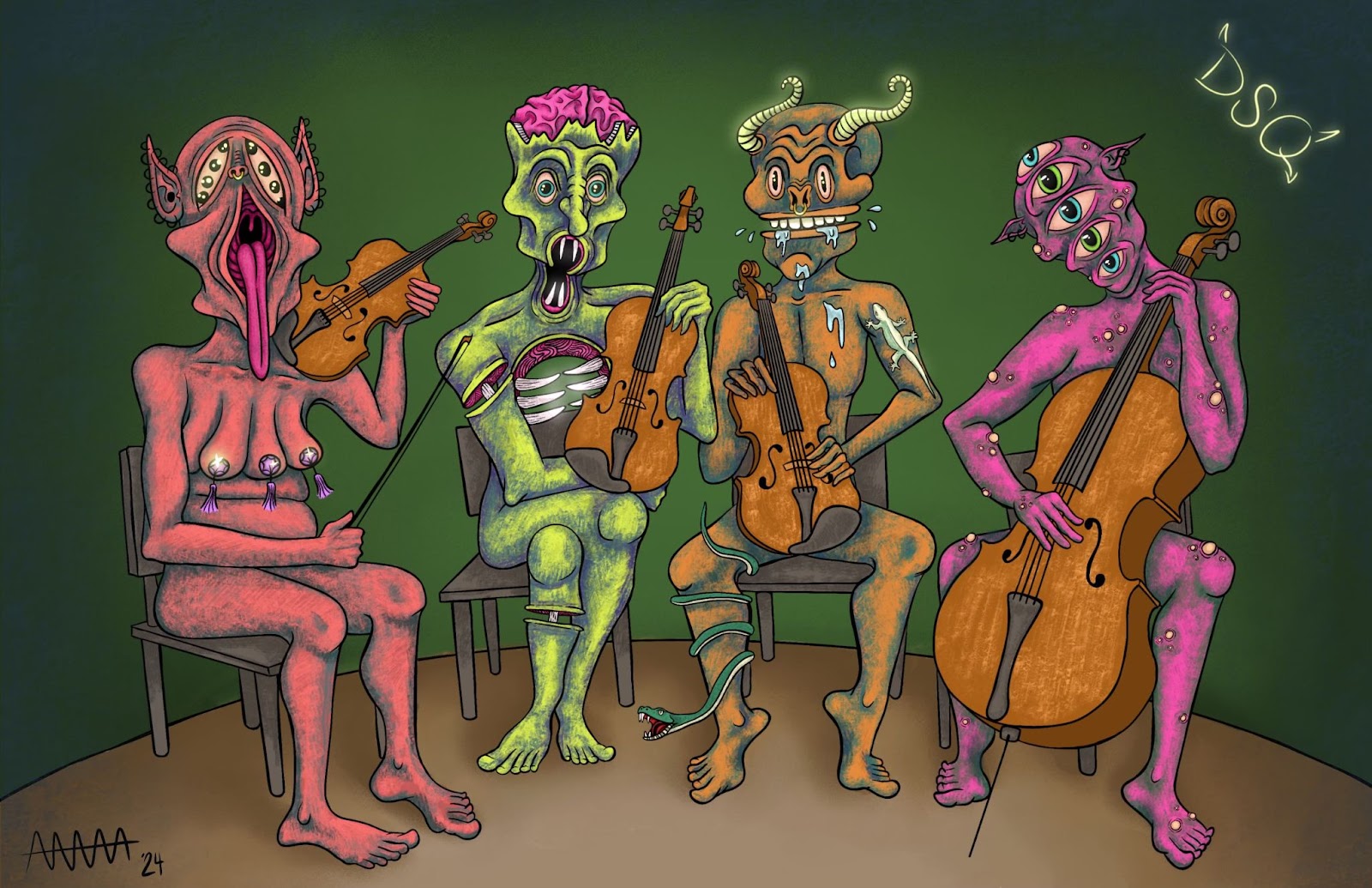
Formed in 2023, the Devereux Quartet came together through UC Santa Barbara’s (UCSB) music department. Since then, they have developed a distinctive sound that reflects both their classical training and their collaborative, exploratory essence. The quartet consists of Bridget Boland, who plays the viola, Shifa Leduc-Akbar, who plays the violin, Ellie Lim, who plays the violin, and Srijani Bhattacharya, who plays the cello. Originally playing in driveways of the 68 block in Isla Vista (I.V.), the quartet’s first single with Corliss is out now, titled “Mt. Rainier Getaway,” with a full album on the way.
Their upcoming album began when Corliss approached Boland with the song “Faster Than Light,” which he originally intended for the piano and his voice, but “he had the idea that it might sound cool to have strings involved,” thus entering the quartet’s role. Over time, the collaboration ended up with nine full songs. Boland reflected on the process, saying, “We weren’t that close with him at the beginning of the project, but we got to know him through his lyrics and his musical self before we got to know him as his personal self,” later describing it as an “intimate” way of becoming friends.
Initially an ambitious dream, the performance at the Soho was a result of their goal to conduct a show with a full orchestra. The show consisted of original quartet parts that they wrote and boosted to be played by string members of the orchestra. Following their performance, Monkfish had their time on the stage too, another band prevalent in the Santa Barbara community.
When asked about the quartet’s identity and sound, Lim shared that their sound is “the heart behind it. [She] would hope to describe [their] sound as warm and inviting,” highlighting that they are not a “very clean, pristine group of players, but [that they] play like [they] have something to say.” Boland said that they had a lot of “tender moments that can only be pulled off by young amateurs.” Leduc-Akbar added that “there’s a genuine understanding of art and love for individuals’ aspects of musicianship and artistry.”
As for which composers and musical talents the quartet learned about throughout their time at UCSB, they shared that their four musical cornerstones were shaped by Shostakovich, who taught them to explore creative choices, Borodin, who taught them how to be tender, romantic, hearty, and sweet, Dvořák, who taught them about motion, and Mozart, who taught them about precision, balance, timing, articulation, matching, and how to listen to one another.
Rehearsals for the Devereux Quartet are a blend of discipline and spontaneity. With pencils in hand, the quartet approach their run-throughs democratically. They emphasized the importance of giving everyone a fair shot through their three-time method in which an idea gets three tries. If it lands, then the idea sticks, but if they’re not a fan, they move on. As Professor Moerschel of UCSB’s music department told them: “Any idea is better than no idea.”
The quartet is dedicated to making classical music more accessible. They talked about how important it is in a modern setting where young individuals say that they really can’t focus thanks to our screens. They stressed the importance of providing entertainment that can’t be replicated by a screen. There’s something powerful in being in a room where this music is played, where every note resounds in the air and you can feel the intensity of the players’ connection to their instruments and to the audience.
The quartet expressed that music is a crucial and integral aspect of campus and UCSB. Leduc-Akbar pointed out that in I.V., “people are excited to get to know each other and work, play, and jam together.” She later went on to say that I.V.’s accessible music uplifts the community and lets people “see things they’ve never seen before.” It’s the perfect space for both confident musicians and those who are breaking out of their shell.
TBL asked the quartet what they hoped listeners and audience members would take away from the performance. Lim said that people should feel “invited” to their experience: “They’ve participated in an act of making music even though they weren’t on stage with an instrument in their hands.” Boland shared: “I want people to walk away knowing how much it mattered to us that they were there.” Leduc-Akbar expressed that she wants people to feel welcomed and represented in the space, mentioning how representation in classical music was “scarce” in the past, so being in an all-female quartet with some people of color is important to her.
The ensemble created an experience that transported audience members who were privileged to be in attendance. As Boland eloquently phrased it at a midpoint of the performance: “you guys deserve to hear classical instruments, and we deserve to play them.” For updates on future performances, follow the quartet on Instagram: @devereuxquartet.