









Taylor Cusimano
Contributing Writer
Amid the chaos of midterms and the final stretch of spring quarter, students often hear the repeated advice: “Take care of yourself.” But in a world filled with deadlines, expectations, and constant noise, what does this really mean?
Like many others, I’ve found myself caught in the rush, measuring my days by assignments, to-do lists, and late-night study sessions while slowly burning out. Recently, I have started paying closer attention to how stress appears in my life, and I did something small but surprisingly effective: I took a walk.
According to the Oxford English Dictionary, self-care is “the practice of taking action to preserve or improve one’s own health.” In other words, it’s for anyone who needs it — and most of us do. There’s no universal formula for self-care, but research points to one of the most effective and accessible options: walking.
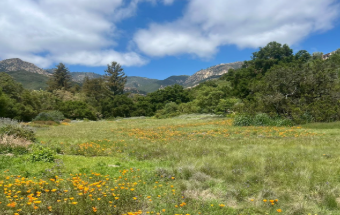
At UC Santa Barbara (UCSB), we’re surrounded by natural beauty. The ocean, gardens, and mountains are just steps away. Yet too often we rush past them, heads down and headphones on. UCSB offers countless mental health and wellness resources, but one of its most underutilized may be the environment. Sometimes, all we have to do is notice it.

In a New York Times article, writer Lindsey Underwood reflected on the value of choosing the scenic route. “It only adds two minutes to my commute,” she claims, “but I usually tell myself I don’t have time. The rare days I venture inside the park, I pass people playing softball, or maybe balancing on a slackline … But that’s the thing about self-care, I guess: It’s taking the time to do something that makes you feel good. Even if it’s just a little bit good, and even if it’s not that nice.”
At UCSB and around Santa Barbara, this mindset can be as simple as leaving five minutes earlier to walk by the beach or choosing the Lagoon Trail instead of the straightforward sidewalk. Even a few extra moments outside can help reset the nervous system.
A 2020 study in the Journal of Environmental Psychology found that a 30-minute walk significantly reduced a negative mood. Clinical psychologist Dr. Lynn Bufka noted, “A walk can disrupt the cycle enough to get us out of the looping thoughts,” adding that even a mild shift in scenery can help redirect attention and bring calm.
Short walks also demonstrate proven physiological benefits. A 2019 study from Frontiers in Psychology showed that slow, intentional walking lowers cortisol levels, reduces heart rate, and activates the parasympathetic nervous system, which supports relaxation and recovery. These effects are especially strong when walking in plant-filled spaces.

In my week-long experiment with mindful walking, the personal shifts were subtle but real. I didn’t unlock some hidden version of myself, but I did feel more grounded. I experienced better focus, lighter moods, and a deeper sense of presence. That’s what self-care really is: It is not about fixing every stressor but creating small moments of stillness amid the daily chaos of college life.
Self-care isn’t always about big gestures. Sometimes, it’s about doing something small and familiar, something that brings a sense of comfort and control. In a New York Times piece, editor Francesca Donner reflected on how her dad’s spaghetti became a form of emotional grounding. Donner relates the memory of her dad’s cooking to self-care, saying, “Nowadays, dad’s spaghetti is my spaghetti: as much therapy as it is dinner. When life starts spinning too fast, I go to the supermarket and get what I need … My world starts to calm just seeing the ingredients collected together in the basket.” It is not really about the spaghetti, but rather the movement. Getting up, walking to the store, choosing ingredients, and making something from scratch becomes a quiet ritual of care. Like walking, cooking is a way of reconnecting to yourself through action. You don’t need anything fancy, just something that focuses you on the task.
UCSB offers beautiful spaces and encourages students to engage with them. The Health & Wellness Program regularly promotes nature-based mindfulness through Wellness Walks, de-stress events, and the reminder to “pause, breathe, and connect with nature.” Initiatives like the Edible Campus Program and Adventure Programs also support intentional movement in nature.
While services like Counseling & Psychological Services are essential clinical resources, self-guided practices like walking are free, accessible, and easy to start. Even something as simple as taking the long way to class can support mental clarity and emotional regulation.
Sometimes, all you need to do is walk.