










Celia Bueno Sanchez
Senior Staff Writer
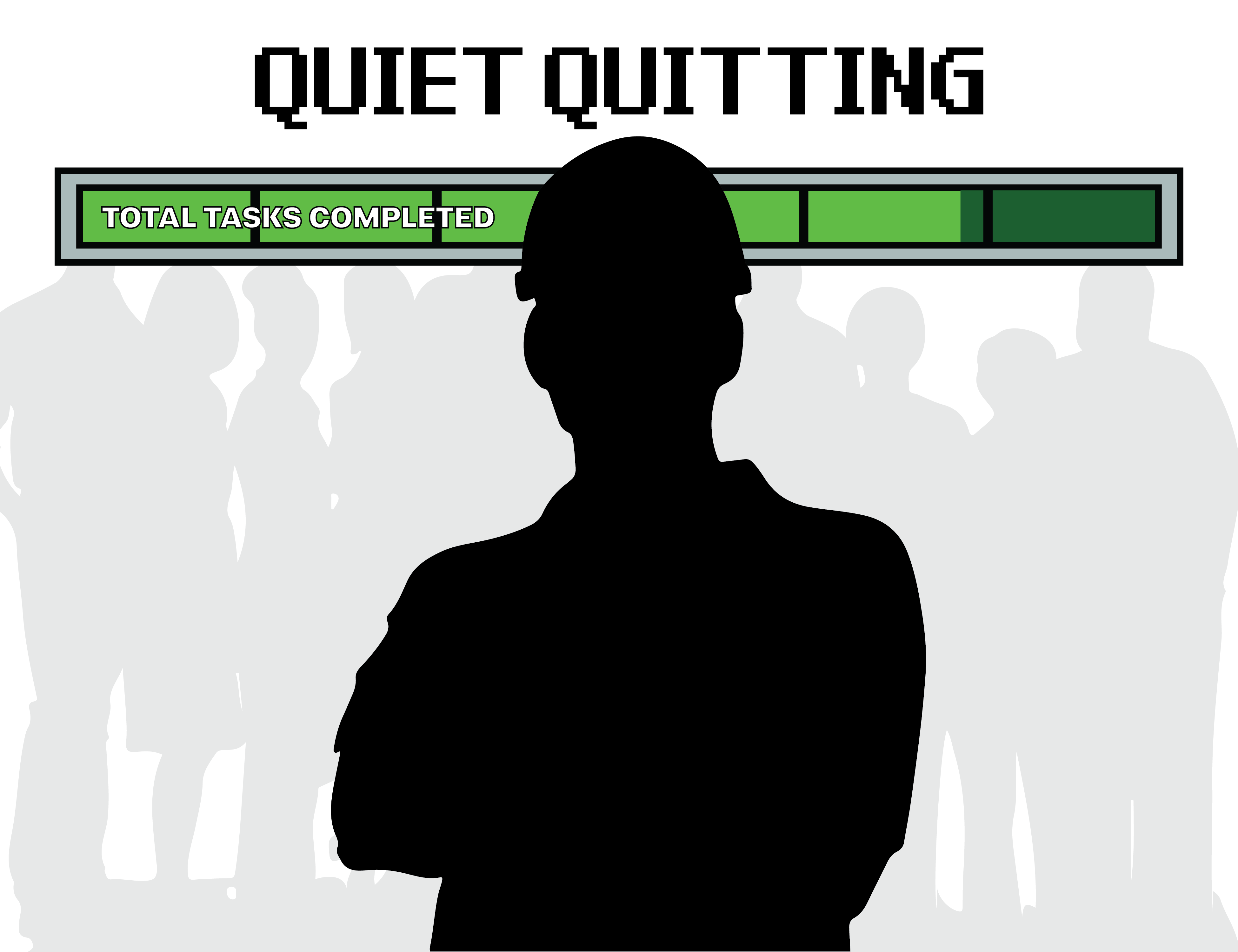
Those empty chairs at meetings that start appearing after months of steady participation. Those tasks that, once handled regularly, simply stop showing up on our to-do lists. And those subtly declining work performances that might seem unnoticeable to other colleagues but in fact, rarely go unseen. Quiet quitting is now a practice that has been so normalized in the 21st century work environment that it seems to not even be worth acknowledging or criticizing. However, quiet quitting and its increasing presence among Gen Z workers reveals a lot about the current workforce, their aspirations, and the ways of thinking that might be influencing the future power structures inside companies, clubs, and other kinds of communal organizations.
Quiet quitting is, in fact, the result of changes in workers’ behavior regarding the execution of certain job-related activities, as well as their perception of work itself — as something that is not entirely separate from personal enjoyment and fulfillment.
This view of the workplace as something that can be enjoyable combined with the ability to say no has made Gen Z the perfect group to perpetuate — or perhaps fall victim to — the practice of quiet quitting. That’s the real question: is quiet quitting a practice that glorifies laziness and the tendency to leave things unfinished, or is it actually a liberating act that has allowed the new generation to prioritize their own wellbeing over the demands of adult life?
Quiet quitting has become a common practice in recent times — a historical moment when everyone is so busy with their own problems that we believe our fading interest in a certain activity will go unnoticed. The New Yorker even dubbed 2022 the year of quiet quitting. In this very same article, the renowned magazine approaches the problem from a generational perspective, addressing a Gallup poll that, after being carried out in January 2025, has shown similar results: workers younger than 34, particularly Gen Z employees, are the most affected workforce segments regarding the issue of employment disengagement.
According to The New Yorker, it was the untrustworthy corporate conformity among post-war workers that made them pass on a completely different message to their millennial children: do what you love. The act of pursuing a career in something we actually enjoy might seem to be the perfect counterweight for workplace disengagement, but what happens when we don’t make it? When we don’t end up working at the position written down in our statement of purpose for our undergraduate program, the result is an absolute disconnection between the need to be productive at the workplace and the genuine willingness to do so.
There is no need for any polls or statistics to affirm that the more we like what we are doing, the more effort we are going to put into it. The interest in the subject studied or the work carried out directly influences the quality of the performance. However, it is worth mentioning that there are some other key trends that influence this decrease in work performance, such as unclear expectations expressed by the employer, the lack of motivation in the search for development, and the absence of a supportive environment in which employees feel that someone genuinely cares about them.
One of the most obvious outcomes of this lack of engagement is quiet quitting, a practice that could not be carried out by this generation if it had not learned to say no. According to an article published by The New York Post: “Everyone thinks Gen Z is lazy – but Gen X and Millennials are secretly envious of their best qualities.”
Gen Z, among many other particular traits, stands out from past generations especially due to the growing awareness of and conversations about mental health in recent years. This perspective has shifted the way Gen Z views work — what used to be “living to work” has now become “working to live.”
Gen Z is characterized by prioritizing personal and mental well-being over professional success. Among other factors, the increased awareness of the link between mental health and career achievement has led to a sense of empowerment within this generation, allowing them to step away from tasks they consider unproductive, uninteresting, or socially uncomfortable.
Yes, yes — that’s all well and good. It’s great that we can pat ourselves on the back and walk past our boss while staring at the floor guiltily after not submitting that assignment they asked for two weeks ago. But as my Spanish mother would say: lo poco gusta y lo mucho cansa (a little is nice, too much becomes tiresome). Gen Z must learn to distinguish and draw the line between what is a legitimate act of self-care and what is, in truth, lazy and rather selfish behavior — something that, in the long run, might bring worse consequences than a 24-hour resignation email.
Quiet quitting, understood as the decline in work performance by an employee, can be seen either as a liberating mechanism that reaffirms the worker’s control over their own actions, or as an act of laziness reflecting apathy and disinterest toward an activity that no longer excites them.
From my personal experience, I’ve witnessed more of the latter than the former. While it’s true that the rise of quiet quitting may stem from the reasons previously mentioned, its overuse has led to a pattern of gradual and systematic disengagement among Gen Z.
And it doesn’t stop at the workplace; quiet quitting can also be observed in sports clubs, cultural organizations, classrooms, and hobbies.
It is one of the most direct consequences of the declining attention span and rising boredom in this generation, a trend closely tied to their deep relationship with the digital era. Quiet quitting may be easy to justify as a liberating act when faced with poor working conditions, but this behavior is seen across all types of environments, even those were the outcome isn’t financial gain but rather enjoyment, education, or personal growth.
Awareness of mental health and the ability to prioritize oneself over the demands of authority are two great gifts granted by modern society. Once again, however, human nature has taken over, and what could have been a liberating act has all too often turned into a convenient excuse for disengagement, a shield used to avoid responsibility under the guise of self-care.