











Abigail Lim
Science & Tech Editor
Why Double?
As is true for many people who double major, I never thought I would pursue two degrees. When I started college, this opportunity didn’t even cross my mind because it didn’t seem like an option. But being able to explore the vast realm of academia made me realize my desire to learn more. Slowly, I realized that double majoring could allow me to connect subjects in nuanced ways that a single major could not.
Cons
Still, many find that a single major is a more sensible choice. Each level of higher education poses significant adjustment challenges, both academic and personal. Completing the degree requirements for one major can be difficult enough with the added stresses of extracurriculars, personal commitments, and a social life. Adjustment is rarely a finite period, and it’s often something double majors live with throughout their undergraduate career.
Two sets of graduation-required classes is also not feasible for all. While options such as minoring can allow a person to explore a niche of their major without the pressure of significantly more mandatory courses, it may be just as strenuous. From experience, pursuing two majors with essentially no overlapping classes is not always easy. Planning academic schedules often years in advance and worrying about finishing degree requirements within four years can add undue stress.
Additional classes may also entail added costs and time. Housing, food, books, and other education-related expenses are often challenging for any student to manage. According to Courtney Brown of the Lumina Foundation, a company that partners with businesses and policymakers to encourage equitable learning paths after high school, 75 percent of Americans believe a bachelor’s degree is extremely valuable for jobs. However, two-thirds do not believe it is financially accessible. Depending on the areas of study, double majors could include unexpected fiscal burdens that many Americans do not feel equipped to handle.
Finally, stereotypes don’t solely exist for specific majors. They apply in subtle ways to people with less typical educational journeys. To some, double majors may be seen as indecisive for not focusing on one subject. Employers with this attitude may also perceive such candidates as lacking depth. Equal attention on two different disciplines can imply a lack of focus on either.
Pros
Despite the rising cost of attending college, double majoring can provide those already in the process of attaining a degree more substance to a major. Oftentimes, an additional major can revitalize a student’s commitment to their discipline by allowing them to look at their area of interest from a new perspective.
While some believe double majors face fewer job prospects, others feel that they afford themselves more employment opportunities. Candidates for jobs that require highly specialized experience, including but not limited to medical doctors or computer scientists, may distinguish themselves by double majoring. Considering factors such as volunteer activities and awards alongside a double major can enrich a candidate’s profile. These days, recruiters and admissions committees take a more holistic approach to evaluation.
Moreover, the job market increasingly focuses on skill and ability rather than on-paper qualifications. Harvard’s Professional & Executive Development lists analytical and creative thinking as the most important skills in a job candidate, followed closely by flexibility, self-awareness, and curiosity. Oftentimes, potential employers aren’t looking for candidates who check all their boxes. They’re searching for people who can enrich a team, provide new insight into groundbreaking projects, and create their own spaces for discovery.
The most frequent comment when I tell others my majors is, “Those are completely different from each other!” I usually reply: “They are on the surface.” What I mean is that pursuing a B.A. and B.S. in two different fields has pushed me to discover the connection between them. I’ve grown more observant in noticing links between material in different classes. The opportunity to explore the intersection of two disciplines provides a uniquely enriched learning experience. Double majoring allows students to examine previously unexplored relationships between subjects. Sometimes, they are the first of their kind and, in their own way, pioneers of their respective fields.
Making a Decision
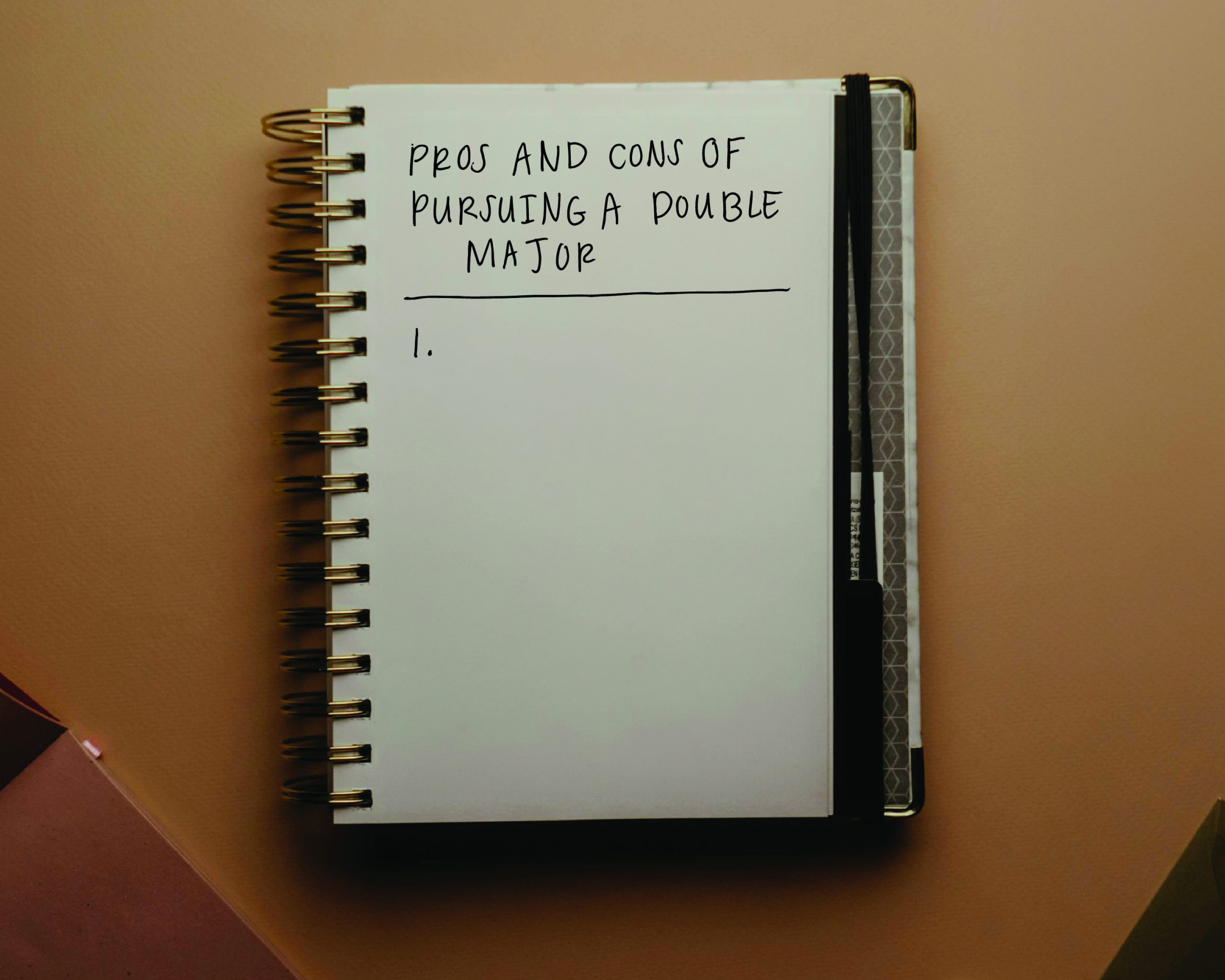
The pros and cons of a double major are often subjective. Most often it is the application of skills and attitudes from any major that matter most to a person’s future career. Beyond double majoring, many higher education programs offer specialized programs such as research-focused J.D./M.D.-Ph.D.s, accelerated M.A. routes, and dual degrees. Ultimately, it’s all about finding the right fit rather than fitting into the program.
While it initially seemed most practical for me to earn a STEM degree, my true passions have always been both biology and the humanities. In my mind, the disciplines inform each other and cannot be truly understood if taught separately. To ask me to give up one meant I could never fully appreciate the other.