






Ariana Isabel Duckett
Editor-in-Chief
UC Santa Barbara (UCSB) offers 53 minors while interdepartmental committees develop new ones year-round. Three years ago, a health humanities minor, including a track in disability studies, was introduced for development.
The minor has recently advanced to “review agencies” for approval, according to Dr. Catherine Nesci, a comparative literature professor who was in the committee to create the minor.
The disability studies track has been dropped.
Disability Studies and Activism, Varying by UC
Maya Clark, who uses she/her and they/them pronouns, is a third-year writing and literature major and external affairs co-chair of the Commission on Disability Equity (CODE) at UCSB, and is disabled. They aspired to receive accreditation in disability studies.
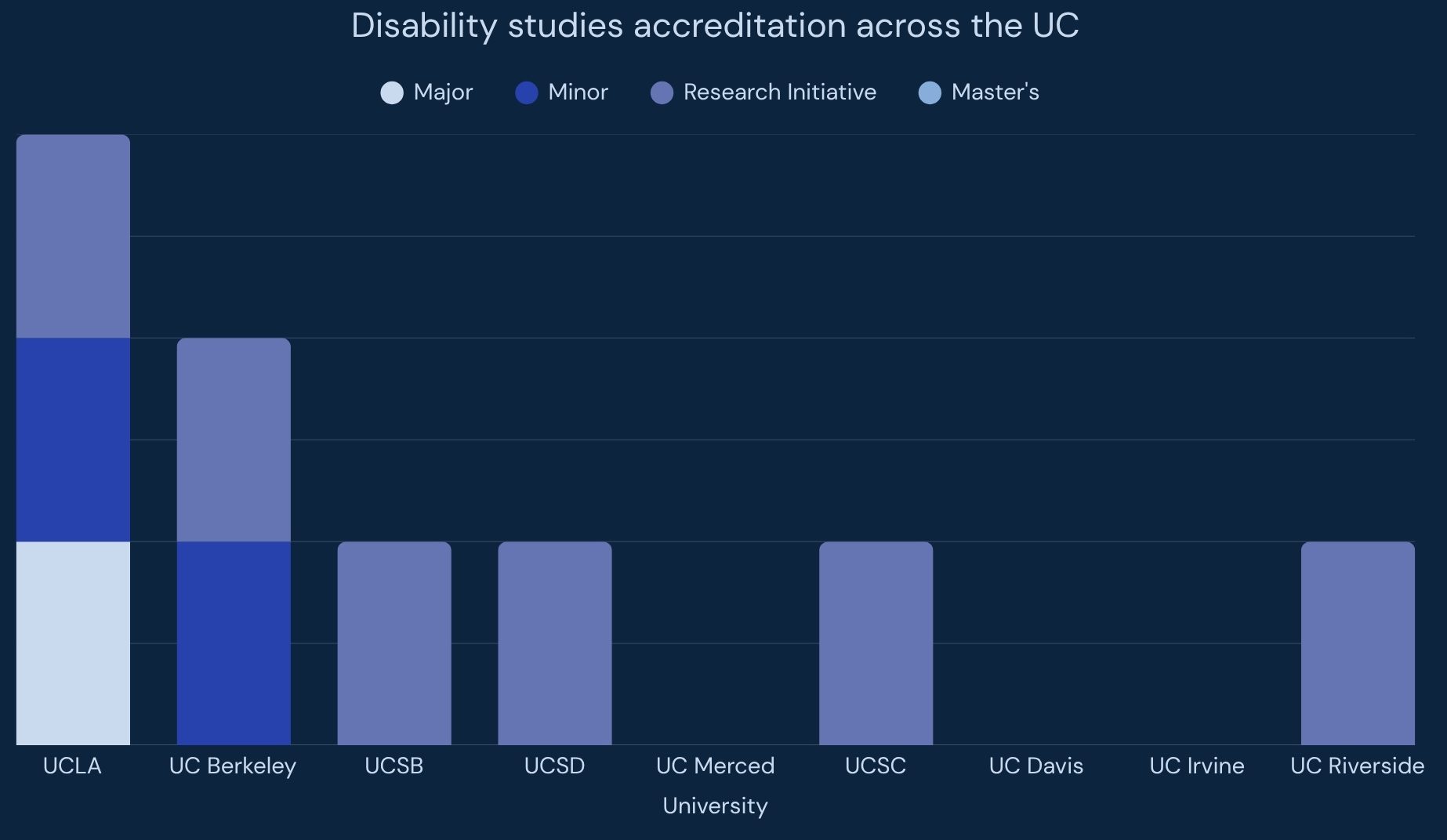
“We are one of the last UCs to implement anything resembling a disability studies course, let alone like a minor or a track,” Clark said. “UC [Los Angeles] and [UC] Berkeley are weeks ahead of us, and yet we pretend that we’re so progressive.”
Each UC offers a variety of courses, degree types, and research initiatives in disability studies. None offer a master’s, and UC Los Angeles (UCLA) is the only one which offers a major.
UC Berkeley (Berkeley) was a critical site for the Independent Living movement with disabled student activist Ed Roberts, and with UCLA, the only one to offer a disability studies minor.
Dr. Nesci grew interested in disability studies from witnessing mental and physical disabilities in her own family, and is a member of the Disability Studies Initiative at UCSB.
The initiative was established in fall 2019 and is a research focus group in the Interdisciplinary Humanities Center. “There’s a scholarly but also an activist dimension in the Disability Studies Initiative,” according to Dr. Nesci.
Several members of the initiative, who could not be reached for comment, were also involved in the development of the health humanities minor.
For the disability studies track, Dr. Nesci was informed that “there were not enough classes” currently being offered that were “fully focused on disability studies.”
The health humanities minor did not have the same issue, with many classes already housed in the Humanities and Fine Arts Department (HFA).
HFA Dean Dr. Daina Ramey Berry, who was in charge of approving the health humanities minor, could not be reached for comment.
“It’s a hard time in higher education,” said Olivia Henderson, a postdoctoral student studying the contributions of neurodivergent people during the Renaissance.
The UC has been in a hiring freeze since March.
As CODE leadership, Clark was informed by Dr. Nesci of the decision to drop the disability studies track. Although disability studies and health humanities are each interdisciplinary, Clark described them as “two different fields.”
Health humanities is “not the disability-informed version of disability studies,” and “disability studies isn’t necessarily about health so much as, like, the social act and reality of being disabled,” according to Clark.
Disability Studies at UCSB
Dr. Nesci estimated that 150 students have taken her disability studies classes, and is retiring in the fall. She hopes other professors will be able to take on her courses and cross-list them in their departments.
Disability studies “[is] a very rich topic,” Dr. Nesci said. “It’s a topic that makes us think about what makes us human.”
Though not directly involved with the development of the minor, Henderson’s involvement in the Disability Studies Initiative has helped her connect with scholars in similar areas of research.
The minor would benefit students of any major and help them “focus on how their field can better support disabled or neurodivergent people,” Henderson said.
The popularity of disability studies classes is an indicator of the student body’s interest in “learning about these things” and “[supporting] their disabled and neurodivergent peers.”
“I think if we’re going to have a feminist studies department, and we’re going to say that we value intersectionality and everything, then we should have a disability studies department,” Clark said. “It’s not like it’s a new field anymore. It’s not like the [Americans with Disabilities Act] hasn’t existed for thirty years longer than I’ve been alive.”
In their final year at UCSB and CODE, Clark aspires to continue advocating for the disability studies minor, as well as establishing a disability cultural center on campus, as they enter the academic field of disability studies. “I am literally a disabled student going into the study of disability studies with an area of expertise where I can be like, ‘Guys, do I need to recite the statistics to you? Do I need to be the statistic?’” Clark said. “How many times do I have to enter a room in my wheelchair for you to understand?”