




Leslie Nguyen
Contributing Writer
Sonny Lata Yiu, a Chinese-Filipino painter, children’s book illustrator, and senior in the College of Creative Studies (CCS) at UC Santa Barbara (UCSB), celebrated the closing reception of her exhibition “Once Upon A Time, Again” on April 16.
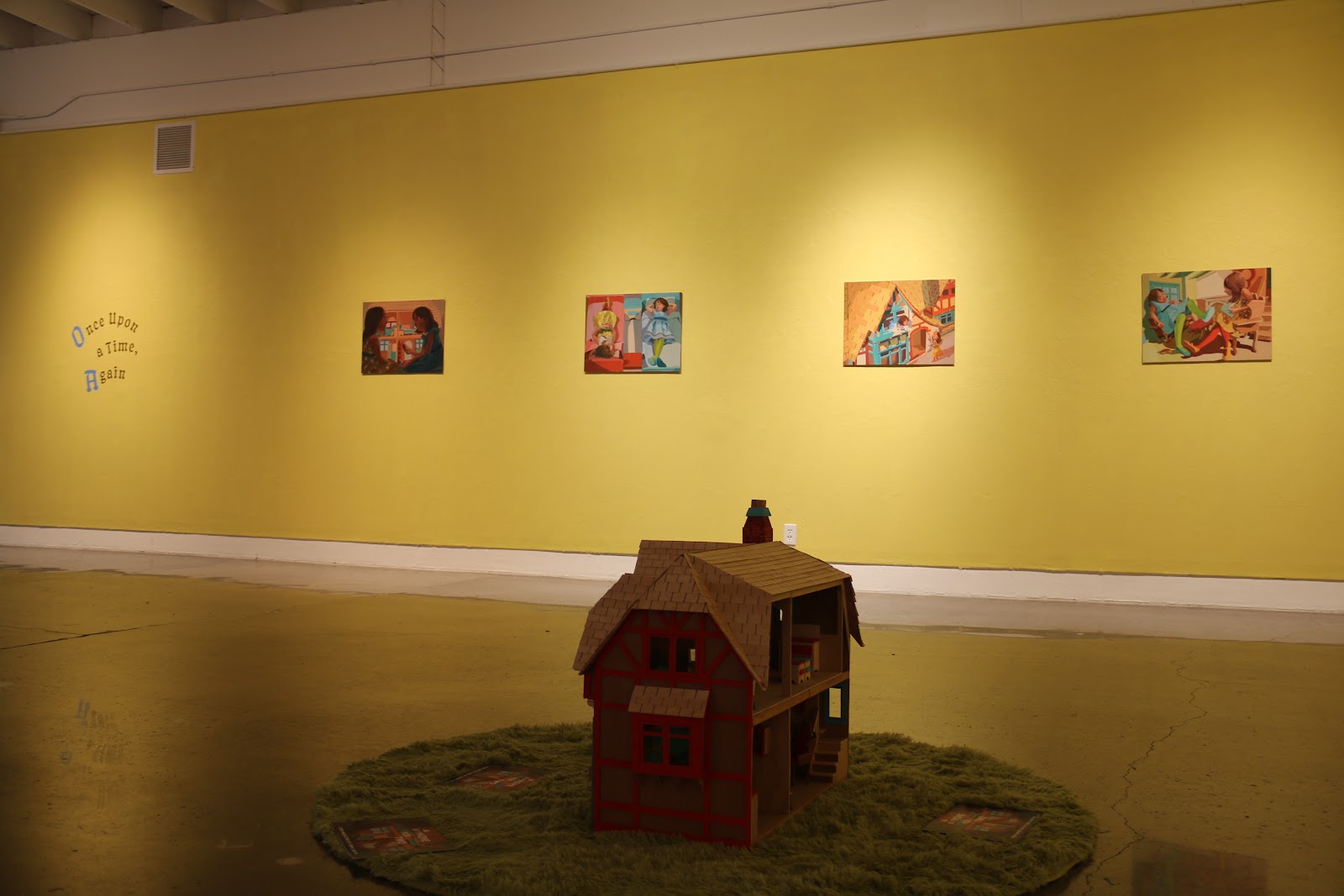
Stepping through the doors opened a portal into the pages of a bedtime story. Dim lights spotlighted the paintings, with Yiu’s narrative unfolding across pastel walls. At the gallery’s center, a handmade dollhouse rested on a rug, encircled by her self-published book “A Home for Two” — an anchor for her retelling of growing up alongside her twin. A zine provided visitors with a chapter book guide to the collection.
Created to share her joy, the paintings invited viewers to approach deeper topics with childlike curiosity. By recognizing nostalgic elements first, they could begin identifying foreign ones and ask: where does this belong? A question many Asian Americans ask themselves on a day-to-day basis.

Yiu’s take on the classic tale Cinderella demonstrates this process. At first glance, these paintings seem familiar — the iconic blue ball gown, chores, and a glass slipper. But Yiu reveals to The Bottom Line (TBL), “The girl in it is not Cinderella; it’s an Asian American person.”
By re-painting the tale, Yiu recenters the narrative: “Being forced to work in a household of abusers, where she cannot stop working, cannot go to the ball, cannot stop serving them — that’s the narrative pushed on Asian Americans.”
However, cultural contribution doesn’t guarantee acceptance. In the second piece, “Asian Cinderella” stands at the base of a staircase. Behind her, a movie-accurate Cinderella doll lies on its side, casting a shadow over her. The contrast echoes a quiet question: “You have to contribute — so how do you contribute culturally?” Yiu asks.
The answer lies in the character’s hand: a teapot, American guidebook, and green card. With these offerings, she will ascend the stairs, hoping for her oppressor’s acceptance.
In the final piece, a young girl in a Cinderella costume rises out of the frame, overshadowing her toys: a plastic doll, teapot, and slipper. But these are not just playthings; they represent what children of first-generation immigrants believe they must replicate to belong in America.
Subverting the lighthearted tone from earlier, Yiu breaks the fantastical facade. The cycle is ongoing, “perpetuated from generation to generation — you work hard, you’ll be accepted here.”
But compliant assimilation into a country that continually isolates foreign identities is never enough for full acceptance. Still, the pressure to conform is inherited through childhood observation and later imitated in adulthood. “Now this girl is getting up from playing with these things, and she’s gonna go out into the world and do those things,” Yiu concludes.
Yiu’s “Fairy Tale Series” began with one painting in particular, titled “What Garden Do You Come From?”

Yiu tells TBL that the viewer is invited to wonder, following the logic of the Cinderella set, “Oh, it’s Alice in Wonderland — what is the story really about then?”
Reimagining familiar stories allows Yiu to share her experiences. Through universal fables, she explains, “You can always shift things to emphasize what’s important to you.”
Traditionally, stories are told to an audience without room for input, but not Yiu’s. She transforms passive gallery viewing into an interactive storybook reading. “Showing not telling — that’s where the world of illustration comes in,” she explains. Disney icons and vibrant colors pull the viewer in, inviting inquisitive exploration of the fantastical world she created.

For example, the first piece the viewer sees from the “Fairy Tale Series” shows Yiu with an Ariel wig loosely perched on her head, surrounded by Asian snacks and a toy boat sporting an American flag. Asian elements take center stage, but little details hint at the American movie. The visual push and pull between two worlds creates tension: is the background sky or water, the floor earth or sand? Is she Asian or American?
Being an immigrant in America is more turbulent than ever. “It makes me angry when I think about these things,” Yiu shares. Having taken a Filipino Asian American Studies course this past fall, she reflects, “so many things clicked for me, and I was like ‘Oh, that’s what I’ve been feeling and what I feel I need to tell everyone.’”
Having experienced the children’s book publishing industry versus gallery displays, Yiu recognizes that the setting for a standalone piece gives it status: high-brow or low-brow. “I’ve seen a hierarchy of how people perceive the two,” she observes. “Looking at the show, the paintings are things people look at more than reading the book.”
Due to its “low-brow” nature, children’s books often gloss over cultural context to promote whatever the publisher deems digestible to the unsophisticated palette; meanwhile, complex themes are reserved for “high-brow” galleries.
Regardless of medium, artists must consider how the display space shapes audience perception. In galleries, the freedom to curate the environment influences the work’s reception. “When you see artwork in a gallery,” Yiu says, “you see it with a sense of respect that sometimes isn’t given in the studio or classroom.”
While she values this respect, she rejects the invisible barrier separating the viewer from art. Designing the show with colored walls, she challenges the traditional “white cube gallery.” “The white walls are so cold to me. It says, ‘this is an art space, you have to look at the works and don’t touch anything.’”
In curating nontraditional spaces, she maintains the respected gallery space with her own intentionality. “When you change too much, people stop seeing it as a gallery,” she explains. “I don’t want to be seen as a white cube gallery, but I don’t want people to think, ‘oh, you can dismiss everything.’” Her space must invite viewers to engage with the work and create their own meaning.
Looking ahead, Yiu plans to keep experimenting with the narrative perception in her art. Her illustrations will appear in the upcoming German publication “Der Schatz des Schmetterlings” (The Butterfly’s Treasure). As she prepares to graduate this spring, her senior showcase traced her path from not knowing what CCS was about to being a published illustrator and exhibiting artist.