










How “Fackham Hall” Uses Comedy To Tell a Compelling Tale About Social Norms in Both the Distant Past and Modern Society
Sophia Sullivan // Staff Writer
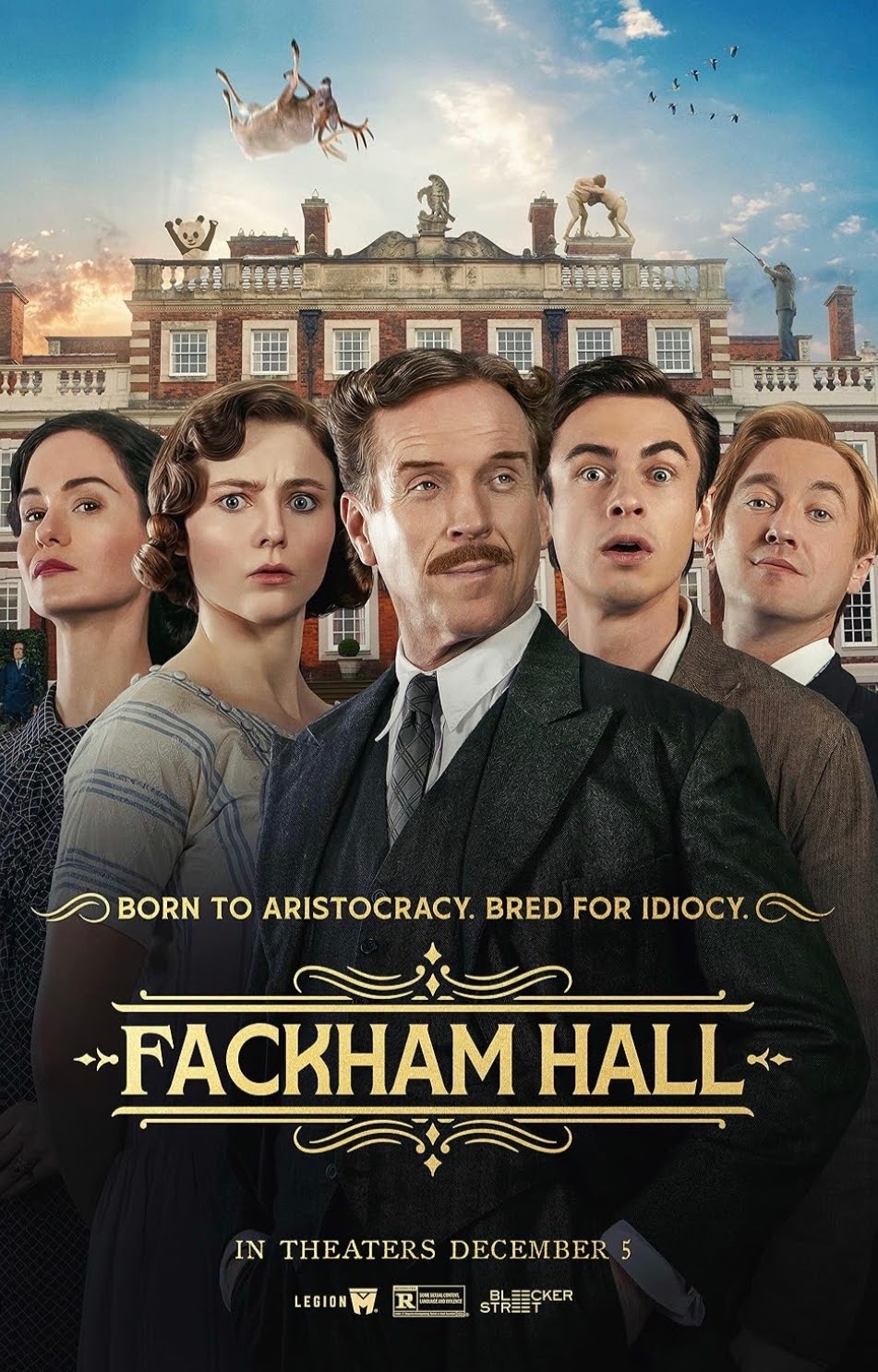
If laughing because it hurts was a movie, then “Fackham Hall” would be that movie.
Jim O’Hanlon’s 2025 flick “Fackham Hall” is a masterclass in comedy, but behind the laughs is an incredibly cutting take on social norms not only for the early 20th century, but for the modern day as well.
The film is set in England in 1931, and, as a parody of “Downton Abbey,” it serves as a fantastic conversational piece regarding rampant sexism, classism, and exploitation during the period.
The first order of business is to analyze what all of the story’s laughable, campy jokes have to say about Depression era society. It’s all the more exciting when you look beyond and juxtapose it with our current societal challenges.
In the very beginning, the Lady of the fictional hall refers to her daughter Rose as a “dried up husk of a woman,” because she’s reached the dismal age of 23. In the context of the film’s humor, one might see it as little more than a dark joke, but the wit is, given the historical context, little more than a buffer for a grim reality. Having a laugh might make it easier to process that women’s worth was very much tied to their youth during that period, youth with a capital “Y.” In doing so, “Fackham Hall” calls out the highly questionable practice.
The film also takes no shortage of digs at the vast divide between the rich and poor of the UK’s early 20th-century society. When the Davenports’ oldest daughter, Poppy, reaches the altar with her fiancé, Archibald Davenport, she backs out and quite literally runs to her true love, Lyroy, who is passing by running his highly successful manure delivery business.
We can and, as the film intends, should laugh at his line of work, but it does point out a truth about class divisions in fictional 1930s England. There was a clear gap at the time between the higher and lower classes, and O’Hanlon calls it out through the painfully funny scene.
The entire film also carries on the repeated gag of clumsy, ignored household staff whom the family patriarch, in some cases, even uses as chairs to sit on. These moments are also played up and exaggerated to make viewers laugh. However, in pointing out through comedy how ridiculous such a thing is, the movie directly chastises the exploitation of workers, both domestic and in factories, which was prevalent from the beginning of the industrial revolution into the 20th century.
“Fackham Hall” calls out the ludicrous societal issues of the period in a wonderfully joking way, making the subject more digestible for viewers, and creates a great story to really get viewers thinking of what many of us believe to be a somewhat distant past.
However, watching it in all of its glory, and I do mean glory as it will have you cringily cracking up for hours, made this reviewer wonder if its subject material and discussion might still hold weight even in this modern era.
Surely we’d all love to believe we are far removed from such societal problems, but if we take an honest look, can we really say that we’re not all living our own modern-day “Fackham Hall”?
As hard as that may be to swallow, when one looks around the world we know and sees the growing financial gap between the wealthy and the poor, it becomes harder to deny. When you take a moment to consider the horribly unappreciated laborers who keep our public spaces in working condition and slave away for fast fashion, an ugly truth emerges. When women are constantly told in the media and in their personal lives that they must stress constantly over every small wrinkle or grey hair, it becomes increasingly difficult to separate ourselves from those who came before us.
In forcing us to laugh uncomfortably at the sad realities of the past, “Fackham Hall” also forces us to admit that some of the same issues may be ever-present and problematic in the current day. It implores all of us to take a stand against them, lest we remain stagnant and become the next punchline of the same very sad jokes.